Google Put 4 TPUs in Orbit — and Its Own Paper Says the Economics Need About 1,800 Starship Launches
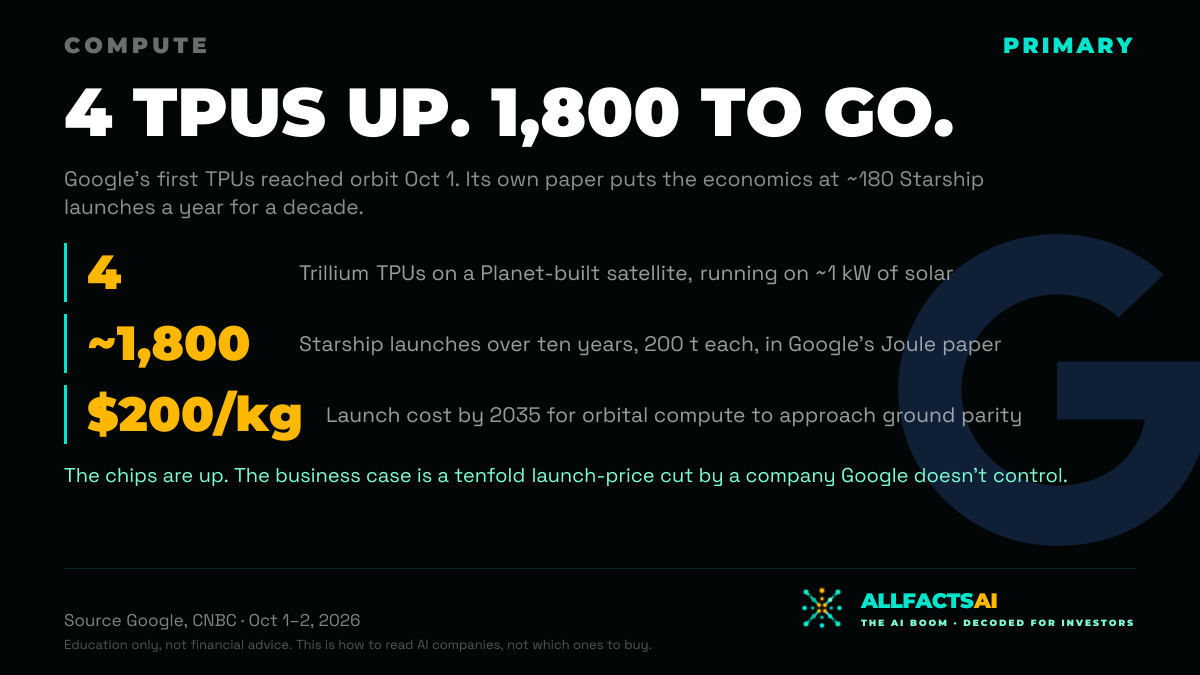
Google's first Project Suncatcher prototype reached low Earth orbit on Oct 1, 2026, aboard SpaceX's Transporter-18 Falcon 9 rideshare from Vandenberg. The refrigerator-sized satellite, built by Planet, carries four Trillium-generation TPUs powered by roughly 1 kW of solar, and is planned to operate for about a year to gather data on how the chips handle launch stress, radiation and the thermal extremes of orbit. Alongside the launch Google published a peer-reviewed paper in Joule on the economics of orbital data centres: by its own analysis, launch costs would need to fall to roughly $200 per kilogram by 2035 for orbital compute to approach cost parity with ground data centres, which it models as about 1,800 Starship launches over ten years — roughly 180 a year at 200 metric tons each — assuming SpaceX sustains the ~20% annual cost-learning rate it has shown since Falcon 1. The full design envisions clusters of 81 satellites at around 650 km altitude linked by free-space lasers. Google first revealed Suncatcher as a moonshot in November 2025; this is its first in-orbit test.
Receipts
- primaryhttps://blog.google/innovation-and-ai/models-and-research/google-research/project-suncatcher-prototype/
- alsohttps://www.cnbc.com/2026/10/01/spacex-to-launch-google-ai-chips-to-orbit-with-planet-labs-satellites.html
- alsohttps://www.theregister.com/systems/2026/10/02/google-launches-first-datacenter-satellite-and-research-that-finds-orbiting-bit-barns-can-work/5300721
- alsohttps://services.google.com/fh/files/misc/suncatcher_paper.pdf
- alsohttps://www.space.com/space-exploration/satellites/spacex-launching-prototype-google-ai-satellite-next-week
Flagged:Primary is Google's own blog post confirming the prototype is in orbit, plus Google's peer-reviewed Joule paper on launch economics (the source of the ~1,800-launch, 200 t, ~$200/kg-by-2035 and ~20%/yr learning-rate figures). CNBC reported the Oct 1 launch independently; The Register reported both the launch and the paper on Oct 2; Space.com previewed the mission on Sept 24 with the four-TPU / Planet-built / one-year details. Rule 7: some outlets headline 1,600 launches rather than 1,800 — the per-year figure (~180) and per-flight payload (200 t) are consistent across every write-up, so the card leads with 'about 180 a year for a decade' and gives the total as '~1,800'. The 15-minute compute windows / cooling-limit detail that appears in some coverage (TechTimes) could not be confirmed in a tier-1 source and is NOT on the card. Google's blog, the paper PDF, CNBC, The Register and Space.com are all egress-blocked from this environment for direct fetch; figures were cross-checked across search extracts of those pages, which agree. Freshness: launch Oct 1, paper coverage Oct 2, built Oct 2. Rule 9: Alphabet's Oct 1 stock move is excluded — it coincided with the Gemini 4 Argon launch (already a card) and cannot be attributed. Distinct story from the Oct 2 Argon card. Company is Alphabet (GOOGL, in the 72-name universe); watermark uses the Google mark via the registry alias.