Anthropic's Robot Study: Today's Robots Can Do 75% of US Physical Work — and Are Cheaper Than a Human for 0.3% of It
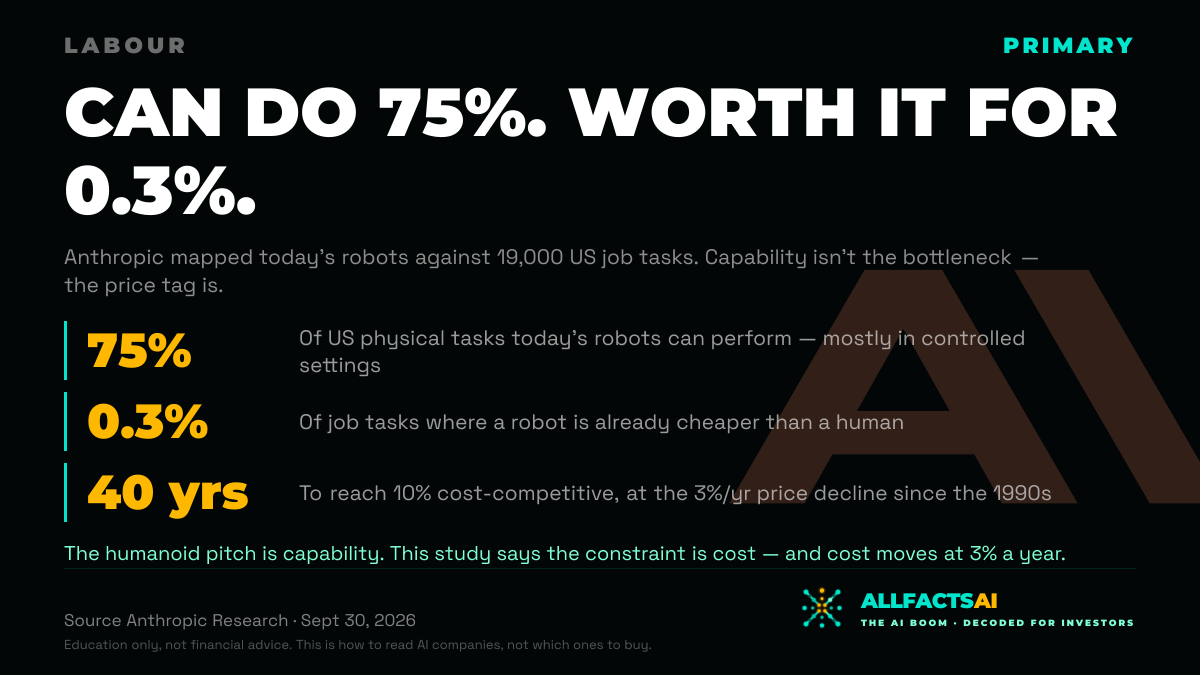
Anthropic researchers Russell Legate-Yang and Maxim Massenkoff published a robot exposure index on Sept 30, 2026, mapping the capabilities of today's autonomous physical machines against roughly 19,000 job tasks across about 900 US occupations in the O*NET database. They find robots can already perform three-quarters of US physical tasks, equal to 34% of working hours, but mostly only in purpose-built, controlled environments — and that robots are cost-competitive with a human worker for just 0.3% of job tasks. At the roughly 3%-a-year quality-adjusted price decline robots have shown since the 1990s, it would take about 40 years for that share to reach 10%. Even in the authors' fast scenario, with costs falling up to four times faster and robots learning new tasks twice as fast, robots do not become cheaper than humans for half of today's physical work until around 2050. Taxi drivers and warehouse packers are highly exposed to robots available now; nurses and mechanics are not. Combined with large language models, about 80% of US working time is exposed to one or the other. Cost estimates in the study were generated with Claude, and the authors are Anthropic employees.
Receipts
- primaryhttps://www.anthropic.com/research/what-work-can-robots-do
- alsohttps://finance.yahoo.com/technology/article/anthropic-study-suggests-blue-collar-workers-have-decades-before-robots-take-their-jobs-115957939.html
- alsohttps://www.tipranks.com/news/will-robots-take-your-job-why-anthropics-study-says-it-could-take-decades
- alsohttps://www.digitaltoday.co.kr/en/view/109951/robots-can-replace-74-percent-of-manual-labor-but-not-yet-cheaper-than-humans
Flagged:Primary is Anthropic's own research publication (Sept 30, 2026; authors Russell Legate-Yang and Maxim Massenkoff), the source of every number on the card: 75% of physical tasks / 34% of working hours performable; 0.3% of job tasks cost-competitive; 40 years to 10% at the ~3%/yr historical price decline; fast-scenario half of physical work by ~2050; ~80% combined robot-or-LLM exposure; ~2%/yr historical gain in physical work robots can do. Yahoo Finance published its own write-up with details beyond the summary (the fast scenario, dexterity examples, the contrast with Dario Amodei's white-collar warnings); TipRanks and Korea's Digital Today also covered it independently. Sourcing caveat flagged to the operator at screening and accepted: no CNBC, Bloomberg, Axios or Fortune coverage was found at build time, so rule 3 passes on count with a weaker-than-usual second source. Freshness: published Tuesday Sept 30, built Thursday Oct 2 — at the 48-hour edge of rule 2, flagged and approved with that caveat. Methodological caveats carried onto the card and into the LinkedIn reply: the authors are Anthropic employees with a stake in the 'LLMs now, robots later' framing, and the per-task deployment cost estimates were produced by Claude; the authors themselves note AI-powered robots could leapfrog current capability and that adoption also faces regulatory and preference constraints. Some outlets round 75% to 74%; the card uses Anthropic's own 'three-quarters'. No stock move is quoted (rule 9 not engaged). Several source domains are egress-blocked from this environment for direct fetch; figures were read directly from Anthropic's page and cross-checked against the three corroborating write-ups, which all agree.